
Are You Really Supporting Multilingual Learners? What EdTech Product Teams Are Missing

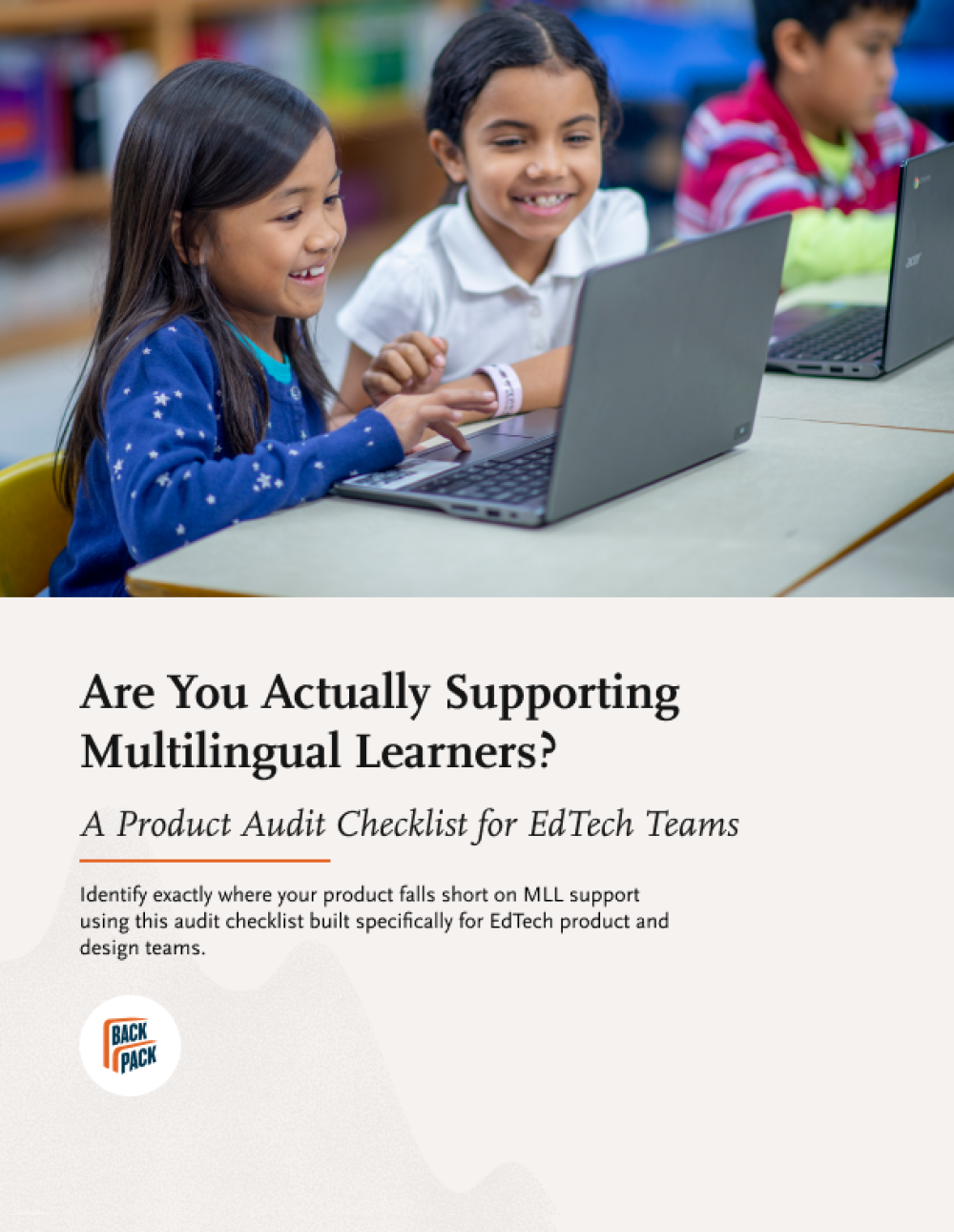
The modern classroom has changed dramatically over the last decade. Today’s students bring a wider range of languages, cultural experiences, and learning needs into schools than ever before. Yet many EdTech products are still designed for a classroom model that no longer exists.
Nowhere is this disconnect more visible than in how products support multilingual learners (MLLs).
For years, translation features in educational technology have been treated as optional enhancements: a button tucked into a menu, a direct text conversion layer, or a lightweight accessibility feature added late in the product development cycle. But as multilingual learners become an increasingly central part of the K–12 population, that approach is no longer enough.
Supporting multilingual learners is not simply a matter of translating content. It requires designing systems that actively reduce cognitive friction, scaffold comprehension, support teacher workflows, and create equitable access to participation and learning.
The EdTech companies that recognize this shift early will build products that are more effective, more accessible, and ultimately more aligned with the realities of modern classrooms.
Multilingual Learners Are Reshaping K–12 Education
The language used to describe multilingual learners has evolved significantly in recent years. While “English Language Learner” (ELL) was once the dominant term, many educators and researchers now prefer “Multilingual Learner” because it more accurately reflects students’ strengths rather than framing them through a deficit lens.
This shift matters because multilingual learners are not a small or temporary population. According to the National Center for Education Statistics, more than 5.3 million students in U.S. public schools are classified as English learners—over 10% of the total student population. In many districts, particularly in states like California, Texas, Florida, and New York, that percentage is substantially higher and continues to grow.
At the same time, classrooms are becoming increasingly linguistically diverse. More than 400 languages are represented across U.S. schools, making one-size-fits-all language support increasingly ineffective.
This diversity creates challenges for schools, but it also creates enormous opportunities. Research consistently shows that multilingualism is associated with stronger cognitive flexibility, problem-solving ability, and executive functioning. Multilingual learners are not a limitation within the education system—they are a reflection of where education is heading.
The question for EdTech companies is whether their products are evolving quickly enough to support that future.
The Real Problem Isn’t Translation—It’s Cognitive Access
Most academic challenges faced by multilingual learners are not rooted in intelligence or capability. They are rooted in access.
Students are often expected to learn new academic concepts while simultaneously translating unfamiliar instructional language in real time. Cognitive Load Theory helps explain why this becomes so difficult. Multilingual learners are frequently managing two separate processes at once:
- learning the underlying academic content, and
- interpreting the language used to deliver it.
When educational technology fails to reduce that burden, it introduces unnecessary cognitive friction into the learning experience.
This issue becomes even more pronounced in content-heavy subjects like science, social studies, and mathematics, where students may understand concepts conceptually but struggle with academic vocabulary, syntax, or context-specific terminology.
The result is often a mismatch between what students know and what they are able to demonstrate.
At the same time, schools are asking teachers to close these gaps with increasingly limited resources.
Teachers Are Carrying an Unsustainable Burden
In many classrooms, multilingual learner support depends almost entirely on individual teacher effort rather than systemic product design.
Consider a typical middle school teacher managing:
- 30 or more students,
- multiple proficiency levels,
- several home languages,
- and limited planning time.
To fully support multilingual learners, that teacher may need to:
- translate instructional materials,
- adapt assignments,
- create sentence frames and glossaries,
- differentiate reading supports,
- and communicate with families in multiple languages.
Most educators simply do not have the time or staffing support to do this consistently at scale.
As a result, teachers are often forced into roles far beyond instruction. They become translators, accessibility specialists, curriculum adapters, and workflow managers on top of their existing responsibilities.
This is not merely a staffing problem. It is a product design problem.
Too many EdTech platforms assume that language scaffolding will happen outside the product experience rather than inside it.
Why Most Translation Features Fall Short
Many educational products still approach multilingual learner support through what could be called translation-layer design.
In this model, translation exists as a separate utility layered onto the product experience:
- static text conversion,
- generic machine translation,
- or isolated accessibility tools disconnected from instruction.
While these features may provide surface-level access, they rarely support meaningful learning.
Effective multilingual learner support requires something deeper: scaffold-native design.
Instead of asking:
“Can this content be translated?”
Product teams should ask:
“How would an expert educator scaffold this learning experience if they had unlimited time and resources?”
That shift fundamentally changes how products are designed.
Scaffold-native systems recognize that learners need varying levels of support depending on:
- language proficiency,
- academic context,
- content complexity,
- and instructional goals.
This means multilingual learner support should not exist as a single feature. It should be embedded throughout the product experience.
What Intentional MLL Design Actually Looks Like
When language support is integrated intentionally, EdTech products become more adaptive, flexible, and instructionally effective.
Rather than offering only full-text translation, strong systems provide multiple layers of support, including:
- side-by-side bilingual views,
- inline vocabulary scaffolds,
- sentence-level clarification,
- audio pronunciation support,
- visual reinforcement,
- and proficiency-based adaptation.
This mirrors how effective teachers already differentiate instruction in real classrooms.
Recent advances in AI-powered translation and natural language processing are making these experiences increasingly feasible. Modern transformer-based language models can now provide significantly more contextual accuracy than earlier translation systems, especially when paired with instructional supports and educator oversight.
But the real opportunity is not simply automation—it is workflow transformation.
When multilingual support is embedded directly into the product experience:
- teachers spend less time manually adapting content,
- students access concepts more independently,
- and schools can scale support more consistently across classrooms.
Multilingual Support Should Extend Beyond Instruction
One of the biggest mistakes in EdTech design is limiting translation to academic content alone.
Language barriers affect every layer of the educational ecosystem, including family communication, peer collaboration, classroom participation, and social belonging.
Family engagement, for example, is one of the strongest predictors of student success. Yet many families struggle to participate fully because school communication systems are not designed with multilingual access in mind.
When communication platforms include automatic language support for:
- progress updates,
- announcements,
- assignment summaries,
- and teacher messaging,
schools create stronger relationships with caregivers and improve student support outside the classroom.
Similarly, multilingual support can transform peer interaction. Features like real-time discussion translation, multilingual collaboration tools, and translated peer feedback systems help reduce participation anxiety and create more inclusive classroom dynamics.
Language support should not only help students consume information. It should help them participate confidently in the learning community itself.
The Product Opportunity for EdTech Teams
For product leaders, supporting multilingual learners is not simply an accessibility initiative or compliance consideration. It is increasingly a market alignment issue.
The schools purchasing educational technology today are serving rapidly changing student populations. Products that fail to support those realities will increasingly feel outdated, burdensome, and misaligned with classroom needs.
Meanwhile, products designed with multilingual learners in mind often become better for everyone.
Designing for multilingual access naturally encourages teams to:
- simplify interfaces,
- clarify instructional language,
- reduce unnecessary complexity,
- support multimodal learning,
- and improve accessibility overall.
These improvements benefit:
- struggling readers,
- students with learning differences,
- younger learners,
- and even native English speakers encountering unfamiliar concepts.
In other words, designing for multilingual learners often leads to stronger product design universally.
What Product Teams Should Prioritize Next
For EdTech companies looking to improve multilingual learner support, several high-impact opportunities stand out:
Adaptive Language Scaffolding
Allow students to customize support levels based on proficiency and confidence rather than forcing a single translation experience for everyone.
Two-Way Translation for Collaboration
Enable multilingual communication inside:
- discussion boards,
- peer review systems,
- collaborative projects,
- and classroom messaging tools.
Integrated Accessibility + Language Support
Language scaffolding should work seamlessly alongside accommodations, accessibility settings, and personalized learning supports.
Family Communication Infrastructure
Build multilingual communication directly into parent engagement systems rather than treating it as an external workflow.
Context-Aware AI Assistance
Use AI to support instructional clarity, vocabulary explanation, and comprehension scaffolding—not just literal translation.
The Future of EdTech Will Be Multilingual by Default
Multilingual learners are no longer a specialized edge case in education. They are increasingly representative of the modern classroom itself.
The EdTech companies that continue treating translation as a lightweight feature will struggle to keep pace with evolving school needs. The companies that embed multilingual support into the foundation of their product design will create experiences that are more inclusive, more effective, and more scalable.
Ultimately, this shift is not just about language access. It is about building educational systems that reflect how students actually learn.
And increasingly, that future is multilingual.