
The Benefits of User Personas for Your EdTech Product

After more than 20 years in EdTech, I’ve seen how the benefits of user persona research extend beyond better learning outcomes or improved usability.
Persona research helps you prioritize features, including the features buyer personas in EdTech have come to expect from competitive products.
It also helps you develop more effective learning content, align your team on priorities, and empower your team to produce more effective work.
With a more streamlined approach to product design and development, your organization will certainly see cost savings and more efficient timelines.
But I think that the real value of persona research lies in how it can be used to guide alignment efforts across your entire company, providing a strong return on investment.
In this article, I’ll explain why buyer personas are the key to unlocking your EdTech product, so you can get the most mileage out of your research efforts.
I’ll also detail how to extend user experience research beyond EdTech product development, so your entire organization benefits.
Let’s dive in.
How more nuanced personas in EdTech provide strategic direction for your products
EdTech is a unique B2B industry, with end users who are often far removed from purchasing products.
In a typical sales cycle, for example, school administrators buy learning tools, while educators use those products to manage their classroom and assess their students.
You already know how the expectations of school administrators shape how your learning tool collects and showcases student data and how you demonstrate efficacy to discerning administrators.
Shouldn't you apply the same level of nuance to your users?
Capturing education-specific user differences makes a meaningful impact on how you prioritize feature improvements and structure your learning content.
Just think about how different the needs of a curriculum coach and a classroom teacher are. Or the differences between a classroom teacher and a department chair.
Even if all of these personas use the same EdTech tool, their needs for account management will vary widely.
And it's these nuanced differences that affect your design decisions, which features you prioritize, and where you spend your time throughout the product development process.
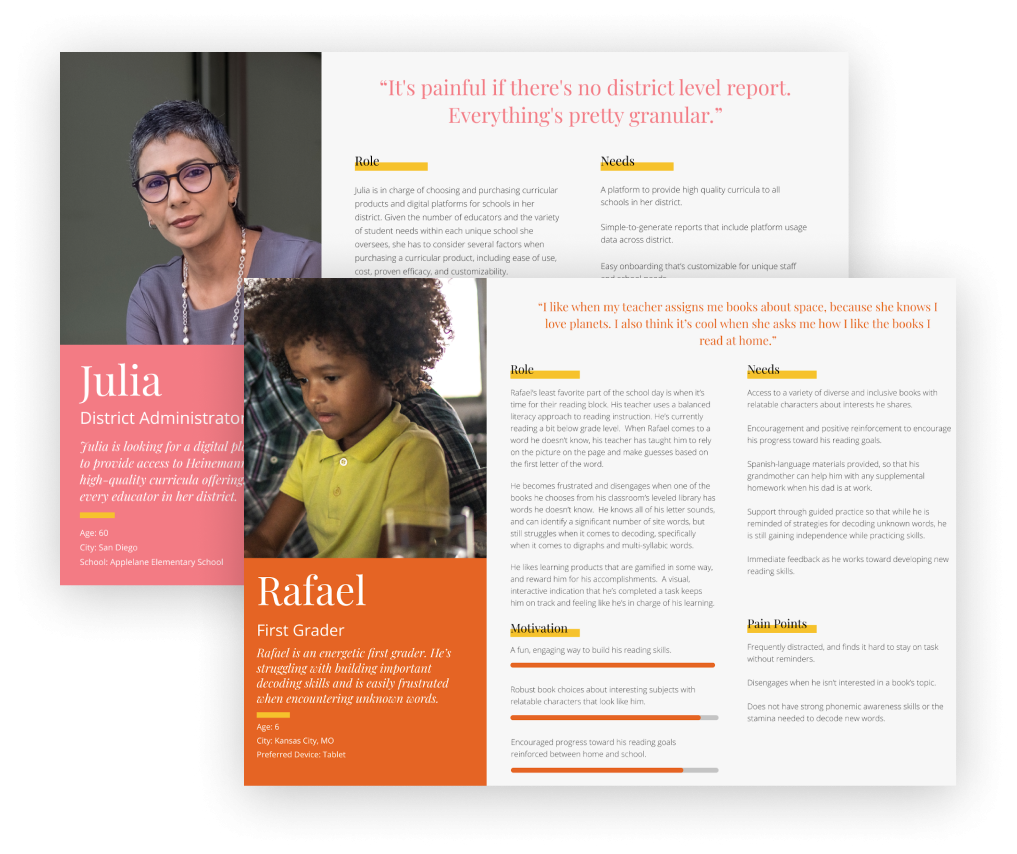
The benefits of user personas in EdTech include aligning your team, prioritizing features, and streamlining product development.
The benefits of persona research for EdTech products
The most immediate value of persona research can be found in its tactical application to your learning tools.
With in-depth, nuanced research of your users, your team can more easily prioritize specific features, create and organize learning content more effectively, and delegate design decision making.
Prioritize feature development
When you develop an EdTech product, there are numerous creative and technology avenues open to you.
EdTech personas are the best way to narrow these options down to the features your customer really wants, rather than the features that will simply fit your business needs.
One easy way to do this is to look for workflow and technology gaps.
For example, you might build out your existing persona data to identify gaps in their current rostering workflow and find ways to optimize for it.
My team also likes to use research data around how comfortable educators are with technology to point clients in the right direction.
In a recent project for PBS Learning Media, for example, we built up qualitative persona data about curriculum needs and types of students served.
That way, we could more easily prioritize which updates to make—and how different an experience might need to be for each user.
Create more effective learning content
Learning content needs for EdTech products are just as nuanced as the personas themselves.
The learning content an educator needs shifts drastically as students age. Even within common age ranges, needs shift between grades and from the beginning of the school year to the end.
EdTech personas help you understand and account for these differences, which will affect how you present learning content in terms of both UX and UI.
Empower internal design teams to work more effectively
Most importantly, EdTech personas are key to helping your entire team build empathy for your users and align on a strategic direction.
Building empathy for users is important because it allows product owners to delegate and spread out decision making.
Empathy also empowers your product team to make both creative and design choices that reflect user needs and challenges.
By making more nuanced, aligned design decisions from the start, you'll streamline your product development process and deliver a stronger overall learning product.
The benefits of persona research for EdTech organizations
In addition to cost savings in UX and UI, you can also use persona research to create “soft” organizational value.
After all, great EdTech persona research creates a shared understanding about your customers among all stakeholders, from the marketing team to your content and instructional designers.
This shared understanding is key to aligning your entire organization around what your users and customers most need.
It’s always exciting to see the clients and partners I work with apply user experience research to their organization in this way.
In fact, some of the biggest, most meaningful brand transformations happen once teams align around a shared understanding of their users.
I’ve seen organizations fine-tune their marketing and sales efforts, reach new customers, and build stronger internal teams—all by aligning their teams around the results of user experience research.
No matter what phase of product design you’re in, well-researched personas help your product team design from a stronger foundational understanding of user needs and expectations.
When adopted widely, personas will help your entire organization build products more efficiently and reap additional benefits from user research as your EdTech product grows.
Ready to unlock the nuances of your EdTech personas? Contact us below to find out how we can help you refresh your user research.

Sean Oakes
Sean has over 20 years of interactive design and account management experience. In 2000, Sean founded SOS, a specialized creative studio based in Brooklyn, NY. He has set the creative vision for the highly regarded firm; the power of thoughtful design and delightful user experience to enable better teaching, learning, and communication.
Sean is a graduate of the Rhode Island School of Design. His work has been recognized by The Webby Awards, Communication Arts, SXSW Interactive, Business Week, The Smithsonian, and Apple.